


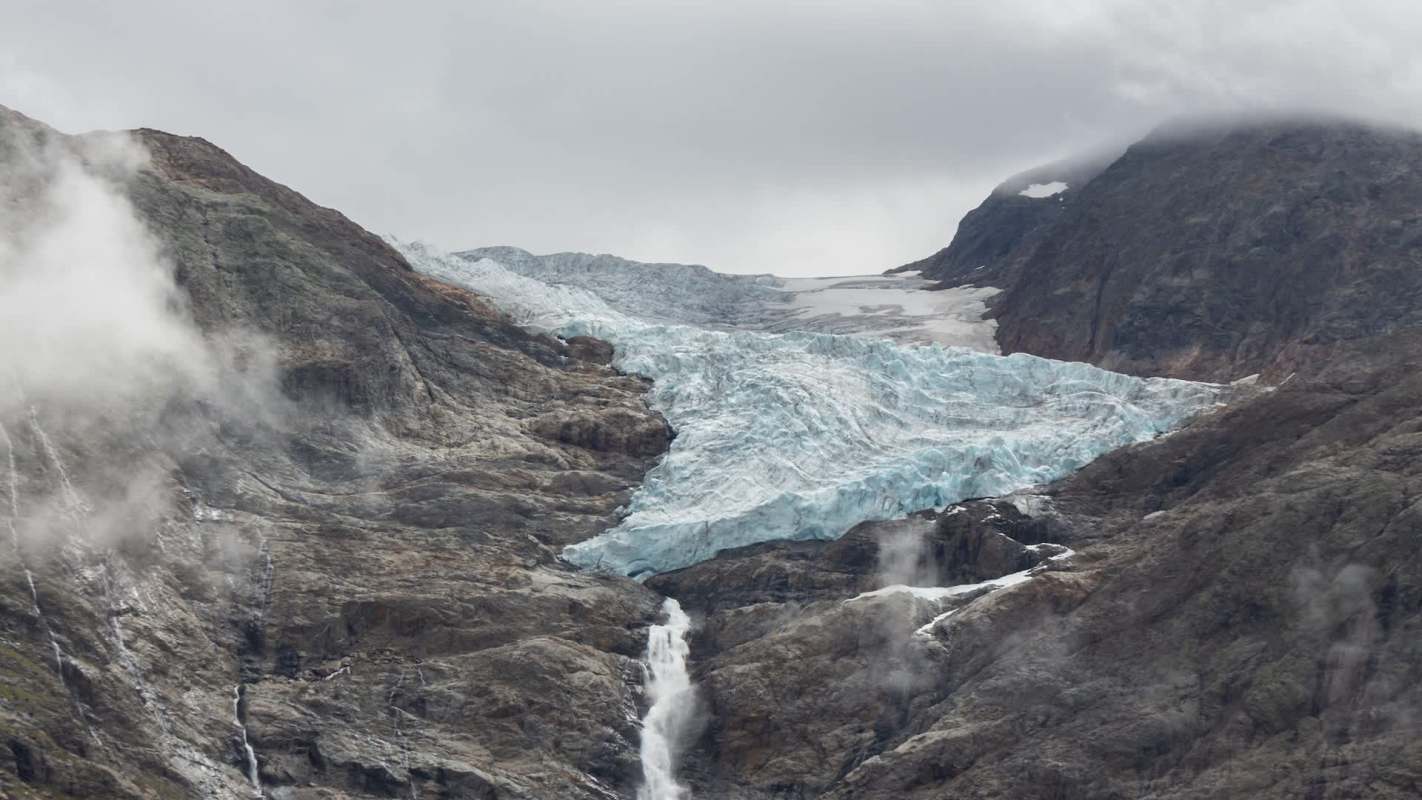
People can now zoom in on one of climate change's clearest warnings through a new interactive map that estimates when specific glaciers may disappear under different warming scenarios. Two glaciers in Switzerland have already been declared extinct.
Here's what to know
The Global Glacier Extinction Explorer, highlighted in an Instagram carousel from creator Age of Collapse (@ageofcollapse), turns global glacier modeling into a searchable map. Users can look up individual glaciers and compare projections for them at 2.7 degrees Fahrenheit (1.5 degrees Celsius), 4.9 degrees, and 7.2 degrees of warming.
At the lowest of those warming levels, glacier losses could peak at roughly 2,000 per year. Projections for 2100 suggest nearly half of today's glaciers may still remain at 2.7 degrees, versus about 20% at 4.9 and fewer than 10% at 7.2.
The outlook in the European Alps is especially stark: roughly 110 glaciers may remain at 4.9 degrees, with that number falling to about 20 at 7.2.
Switzerland has already seen those losses firsthand, with Bella Tola Glacier declared extinct in August 2026 and Urirotstock Glacier also declared extinct in 2026.
Melting glaciers also contribute to sea-level rise, which can intensify coastal flooding far from the mountains where the ice is disappearing.
TCD Picks » Quince Spotlight
💡These best-sellers from Quince deliver affordable, sustainable luxury for all




Climate reports often focus on global averages, but this map shows what those averages can mean for a specific glacier that people know by name, have visited, or depend on indirectly through their water supply.
What's being done?
The Global Glacier Extinction Explorer gives the public, educators, and policymakers a clearer way to understand how emissions choices affect real places. That kind of visibility can help communities prepare for water management challenges, tourism shifts, and local climate adaptation.
The difference between 2.7 and 4.9 degrees is not small — it represents the difference between preserving a large share of the world's glaciers and losing most of them.
The website also offers a direct way to see how quickly conditions may change if warming continues.
Where can I learn more?
Glacier loss is already playing out in real places. The articles below look at what that means for water supplies, ecosystems, and coastlines, from Venezuela and Switzerland to Antarctica.
• Worldwide, scientists tracked the complete disappearance of hundreds of glaciers tied to freshwater loss.
• In Venezuela, the last remaining glacier lost so much ice it was reclassified.
• Studies across 160 glacier sites found long-term impacts on the planet's delicate ecosystems.
Reading through them helps ground the map's projections in what glacier decline already looks like on the ground. It also makes the explorer's warming scenarios easier to connect to water security, biodiversity, and coastal risk.

Get TCD's free newsletters for easy tips, smart advice, and a chance to earn $5,000 toward home upgrades. To see more stories like this one, change your Google preferences here.






