


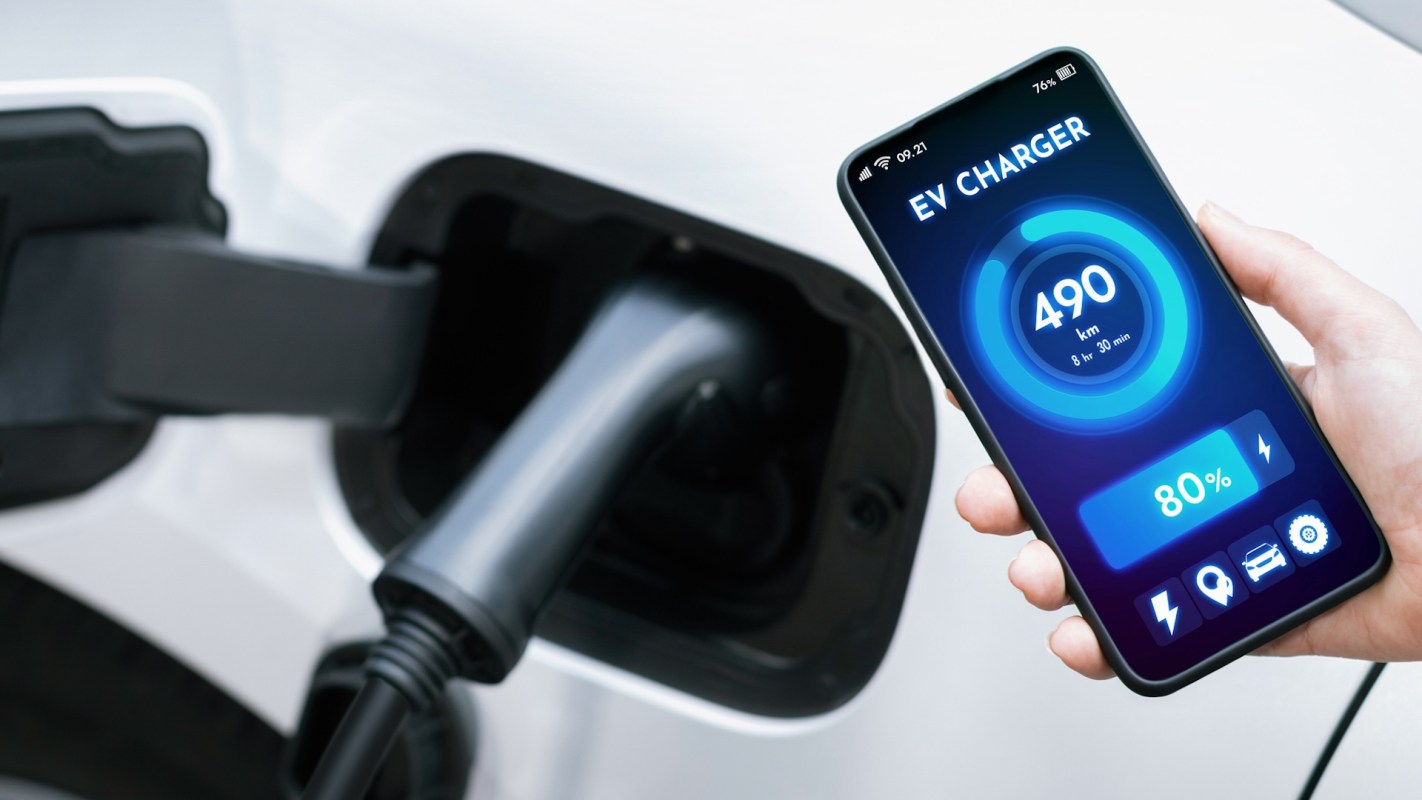
An electric vehicle can add hundreds of miles of driving range during a short charging stop, but filling its battery completely can take considerably longer.
Here's what to know
An EV battery's anode consists mostly of graphite. During charging, it receives lithium ions from the cathode.
As Engadget explained, accommodating those ions becomes harder as the anode fills. That's why charging claims typically describe how quickly a vehicle can reach a partial charge rather than a full battery.
Charging starts with a steady current flowing into the cell while voltage climbs. Once that voltage maxes out, the pattern flips: voltage stays fixed while the current gradually tapers off.
The vehicle requests less current at roughly 80% charge because the increasingly crowded anode needs more time to absorb incoming lithium.
Pushing electricity through too quickly can leave metallic lithium on the graphite's surface, a process known as lithium plating. That lithium rarely comes back, so the battery permanently loses some of its capacity, and the buildup can grow sharp enough to puncture through and short the cell over time.
TCD Picks » Quince Spotlight
💡These best-sellers from Quince deliver affordable, sustainable luxury for all




More background
Fast chargers typically top out between 50 and 350 kilowatts, though newer hardware can exceed that ceiling, according to Engadget. Home and public charging stations provide several times as much power as a household outlet, which delivers relatively little.
The vehicle's onboard charger limits charging speed because it must convert the alternating current supplied by household outlets and conventional charging posts into direct current.
The vehicle signals to the fast charger how much power it can accept. The charger then converts the electricity to direct current outside the vehicle before sending it to the battery.
The Tesla Model S offered up to 300 miles of range at its 2012 debut, but a full charge from a household outlet required more than 50 hours.
Tesla estimates that the latest Model S can gain as much as 200 miles of range during a 15-minute Supercharger stop.
What's being done?
According to Engadget, BYD is also working to change the battery's internal structure, allowing lithium ions to move through it more easily and supporting faster charging closer to full capacity.
Unveiled in March, the company's second-generation Blade Battery stands its graphite particles upright, which BYD says cuts the distance lithium ions have to travel to settle in.
The company also reformulated the ion-carrying liquid and reworked the cathode so ions exit more quickly.
BYD credits the redesign for cutting internal resistance and heat, which lets the battery draw more current. Engadget says the company's 1,500-kilowatt Flash Charger can bring the battery from 10% to 70% charge within five minutes.
The slowdown has not disappeared, but BYD says its redesigned battery moves that bottleneck much closer to a full charge. Using the same Flash Charger, the company claims a nine-minute session can bring the charge from 10% to 97%, according to Engadget.
Where can I learn more?
To compare fast-charging claims, check the starting and ending battery percentages.
• BYD says its Seagull can charge from 10% to 70% in five minutes on its Flash Charging network.
• BYD's Denza N8 promises a five-minute charge from 10% to 70% and 623 miles of CLTC range.
• Porsche's Cayenne Electric faces a real-world charging test at Toronto's lone 400-kilowatt charger.
• In China, Geely touts four-minute full charges using its 2.2-megawatt charging technology.
• Chery says its new charger adds 311 miles in five minutes.

Get TCD's free newsletters for easy tips, smart advice, and a chance to earn $5,000 toward home upgrades. To see more stories like this one, change your Google preferences here.






